The following portals will be unavailable as part of the transition to the new NDIS Commission portal: Registered providers portal and Applications portal unavailable from 8 pm Friday 9 October to 10 pm Sunday 11 October 2026. All other NDIS Commission portals unavailable 7 am to 10 am on Sunday 11 October 2026. Where possible, complete any tasks in NDIS Commission portals before these times. If a Reportable Incident happens during this outage, please keep all relevant details and submit the incident as soon as possible after the portal is available.

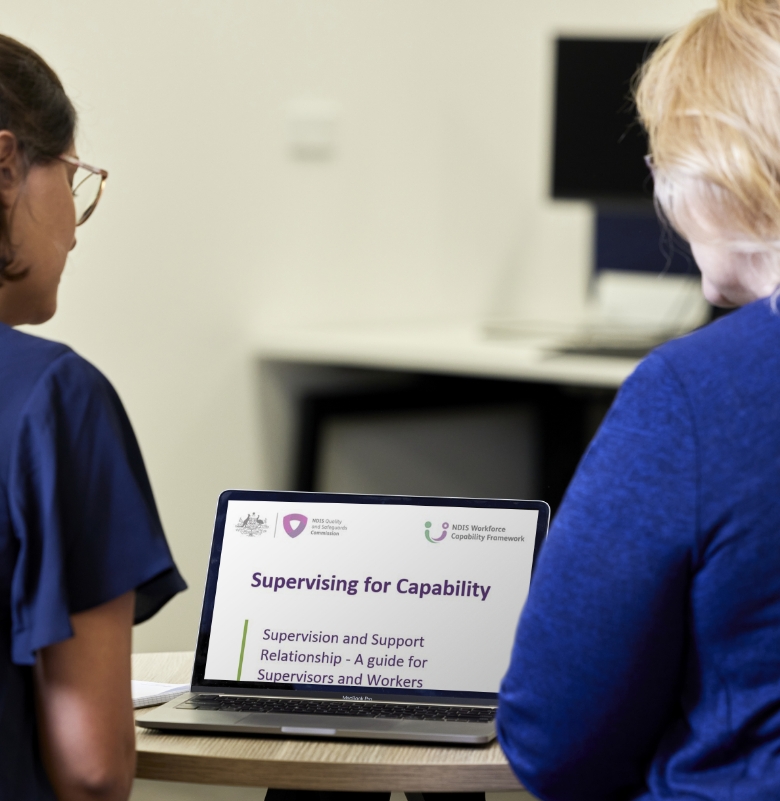
Supervising for Capability
The supervision resources are a set of guides for participants, providers and workers that provide advice and practical suggestions for working together to understand how supports and services should be delivered.
The guides are supported by templates and tip sheets that can be downloaded for use. They can help with setting expectations, and talking to workers about delivering supports to meet the standards participants expect.
Familiar with the supervision guides already?
Select what best describes your situation to view guides.
Further information
For further information see the Supervising for capability videos and Supervising for capability factsheet.
Guiding principles for supervision
Five principles underpin the approach to supervision described in these resources
Collaborative
Participants, workers and supervisors collectively agree on ‘what good looks like’ and how they will work together to achieve it.
Capability-based
The Framework identifies the attitudes, skills and knowledge workers need to provide quality support. They describe both the ‘how’ and the ‘what’ of support.
Respectful
The interests and aspirations of all parties are understood and respected.
Supportive
Effective supervision creates safe and trusted relationships that support worker wellbeing and encourage regular discussion, reflection, and development.
Evidence-based
The organisation uses evidence about how well they are supporting participants and their workers to shape and improve their approach to supervision
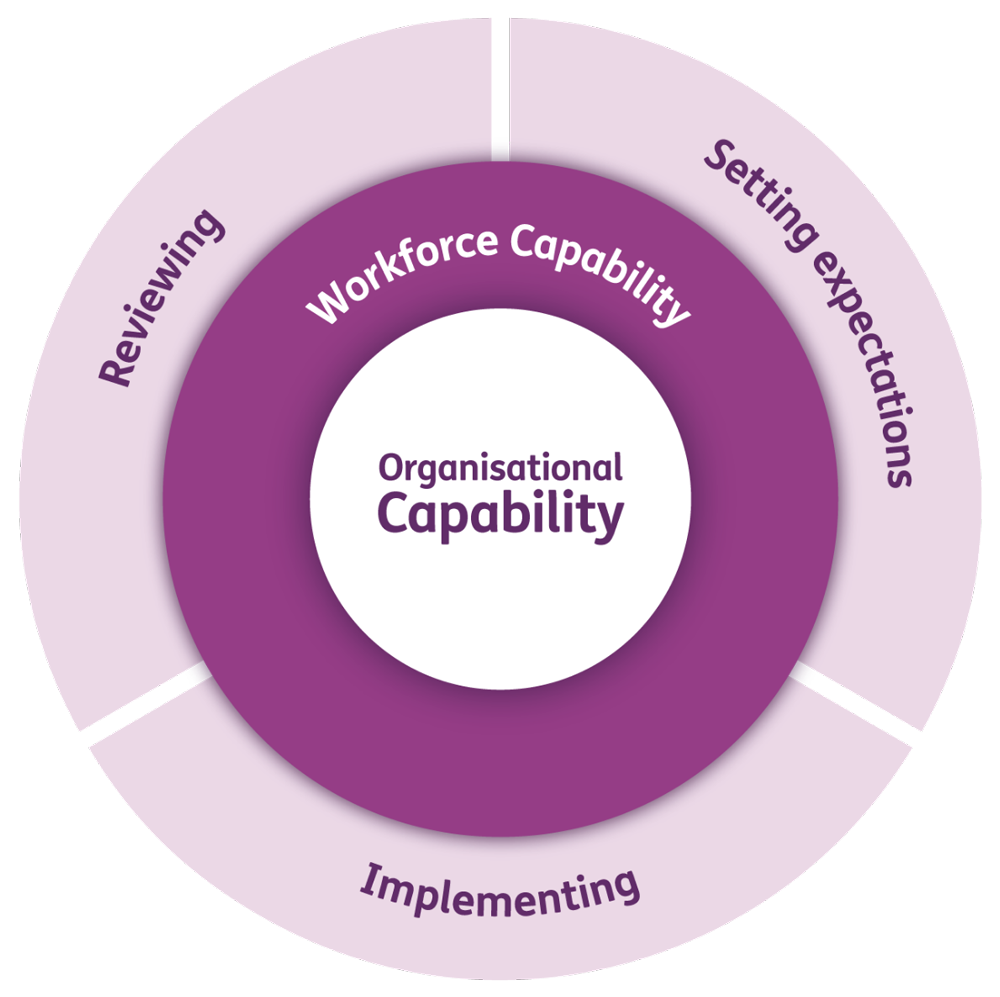
How this resource works
The guides and resources take you through each stage of the supervision process with different information depending on your role and situation. You can download the documents and templates, and modify the templates to suit your circumstances.
How to navigate the guides
Use the navigation bar at the top of the page to select your situation and then choose a guide to view.
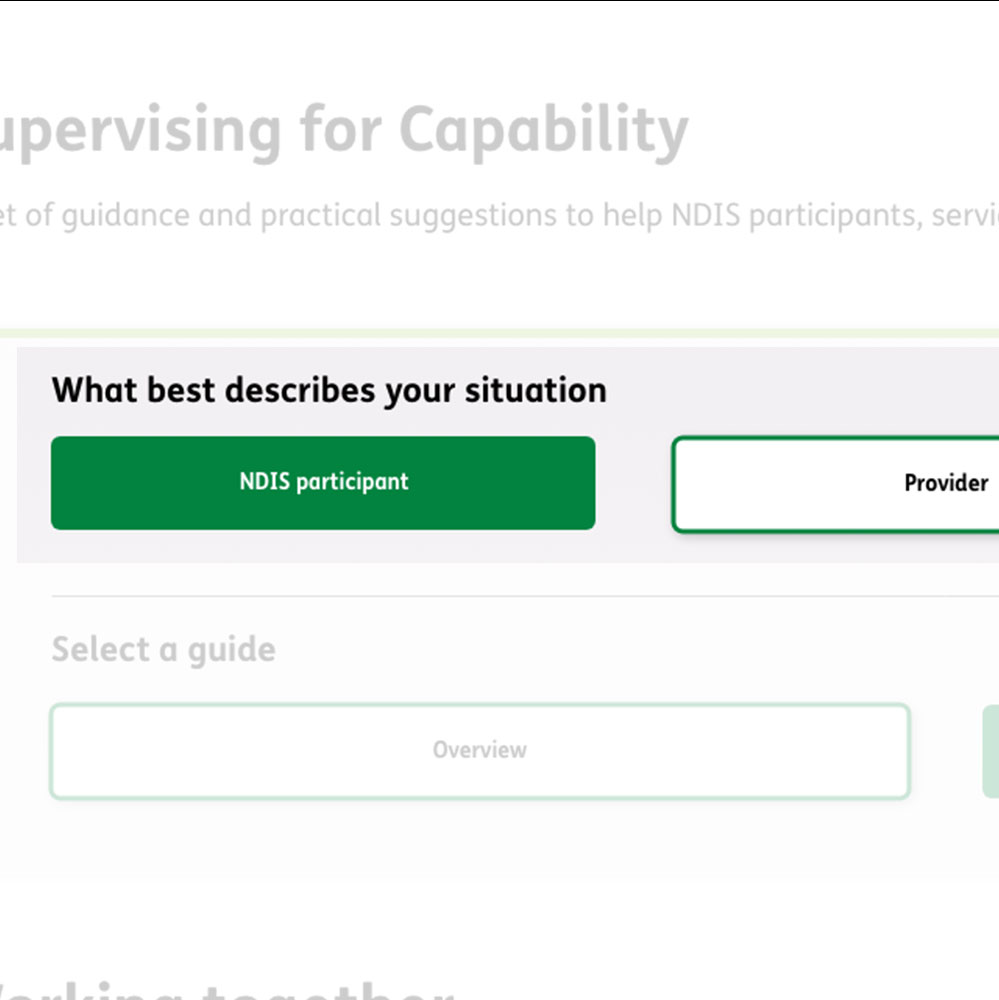
Choose your situation
To get started select whether you are a participant, a provider or a worker.
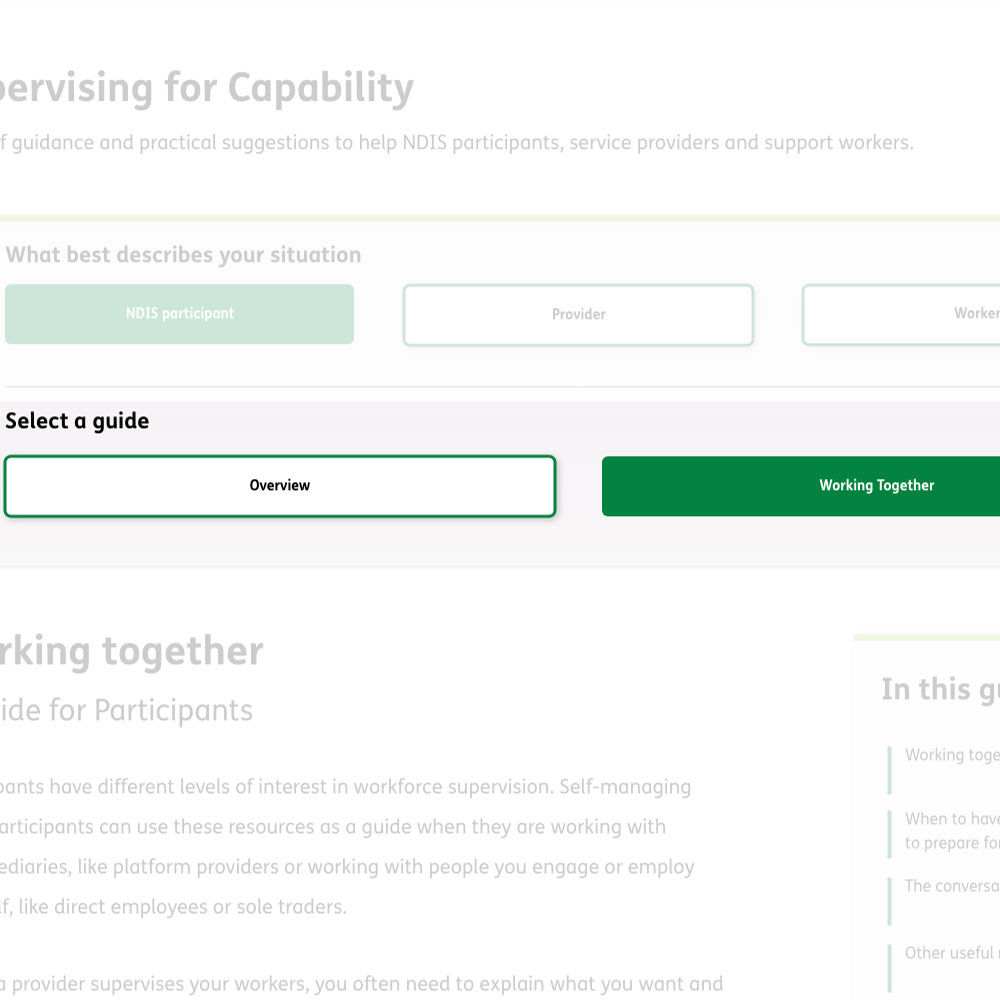
Choose your guide
After selecting a situation, appropriate guides will be shown below. Select the guide button to show content.
Use the in-page menu
For quick access to key content areas, click the in-page menu.
Select your situation
NDIS participant
You are an NDIS participant who wants to provide feedback to workers and NDIS providers
Provider
You are a supervisor or senior leader in an NDIS provider who wants support with the supervision process
Worker
You are an NDIS worker who wants support with the supervision and feedback process
Resources
Supervising for capability factsheet
Word download PDF download Listen to PDF
Easy Read: How to make sure your workers give good support
Word download PDF download Listen to PDF Online
All other Supervision and effective communication resources
Explainer videos
Supervising for capability
Welcome to the NDIS Workforce Capability Framework Supervision Resources. The framework describes the attitudes, skills, and knowledge expected of all workers funded under the NDIS. It is supported by tools, guides, and resources to help participants, providers, and workers to understand ‘what good looks like’ in delivering and receiving supports.
Using the Supervision Resources Working Together Guide is all about being part of the feedback and conversations to increase workers’ capability.
Meet Riva. She's five years old and gets her nutrition through PEG feeding. Her mum Nikita self-manages her NDIS plan and wants to make sure the support workers provide the cashing me
Self-managers hit NDIS plan and wants to make sure Riva’s support workers provide the care she needs. They use the Working Together Guide from the Supervision Resources to give feedback to providers and encourage all the workers supporting Riva to do a good job.
Check out the guide through Nikita and Riva’s eyes. They explore the guide and learn that regular supportive supervision of Riva’s support workers will help them agree on ‘what good looks like’. They use the ‘Preparing for Conversations’ section for tips on having conversations with workers and providers, and find questions and reminders that can guide the conversations in different situations.
Nikita values a personal approach to her daughter's hand-over notes, and wants workers to include information about Riva’s mood after the PEG feed process, and to note the books, toys, or songs that help make the feeding process a normal, fun activity.
Nikita makes observations on how workers are using the handover template, and talks to the supervisor to share what is done well, as well as explain how to use the template effectively. Nikita sets up check-ins with the support workers and supervisor to ensure they are meeting her expectations and providing the best care for Riva.
By using the Working Together Guide, Nikita feels confident in having conversations with her support workers and ensuring that they meet her and Riva’s expected standards of care. The Workforce Capability Framework’s Supervising for Capability Resources helped Nikita speak with her provider and workers. These and other resources available help NDIS participants and their families communicate their expectations and build trusted relationships with their support workers.
The Workforce Capability Framework, or simply the framework, describes the attitudes, skills, and knowledge expected of all workers funded under the NDIS. It establishes a shared language of ‘what good looks like’.
Having conversations with your workers about the support you get can be hard. That's why we've created the Supervising for Capability resources. The ‘Supervising for Capability - Working Together’ guide for NDIS participants in particular can help self-managing participants and participants working with the provider to guide their supports and provide feedback to workers.
Take Rhonda. She’s a self-managing participant who wants to give feedback to her support worker Nan, but isn't quite sure how to go about it. Rhonda reads through the guide to help plan out her talk with Nan. She finds some example questions to ask Nan and ideas on the best ways to keep constructive feedback.
The guide gives suggestions on how to say things clearly. For example instead of saying to Nan ‘I am mostly happy with your support’, Rhonda learns she could be most specific about what she wants and needs by saying ‘I really like it when you check with me first before helping me with a task, because I need to finish one task before I start another’.
The guide also helps Rhonda to plan a difficult discussion about Nan being distracted on the phone a lot lately, and how to solve it. Rhonda asks Nan ‘is everything okay? I have noticed you’ve been on your phone a bit, particularly when I have needed help. I need to make sure I get help when I need it. Can we talk about what's happening?’
By having this conversation Rhonda finds out that Nan had been on the phone with the childcare centre. Nan said knew she had been a bit distracted, and she would organise childcare outside of her work hours.
Rhonda and Nan establish activities like agreeing to check in at the beginning of the shift, and agreeing to have a cup of tea and a chat about how things are going once a fortnight. The helps them work together to find areas where there is room for improvement between Rhonda and Nan.
The ‘Working Together’ has helped Rhonda and Nan set clear expectations for ‘what good looks like’. Since agreeing on how to work together, Nan feels supported and valued, and that's leading to better outcomes for Rhonda.
You can find the ‘Supervising for Capability’ resources on the Workforce Capability Framework website.
Training and supervising for capability
The Workforce Capability Framework, or simply the framework, describes the attitudes, skills, and knowledge expected of all workers funded under the NDIS. It establishes a shared language of ‘what good looks like’.
Providers and workers will find the ‘Supervision for Capability’ resources and the ‘Training for Capability’ guide valuable and continuously improving the delivery of support. This could include supervising workers, giving feedback or identifying training needs.
If you have questions like ‘How am I supporting the development of my workers?’ or What training do workers need?’ or ‘How are participants giving feedback to worker?’ then these resources are for you.
As providers, you can set your workers up for success by exploring the ‘Training for Capability’ guide. Here you will find information on identifying the drivers of training priorities, identifying knowledge or experience gaps within your organisation, and information to help you identify suitable training programs.
Handy templates are available including a tool for workers to capabilities, and a Training Selection Score Sheet to help you when choosing training providers. There are also tips on evaluation training to ensure you are getting good outcomes for workers and participants.
Training to meet capabilities is important for all workers, including management and senior leaders.
When it comes to continuous improvement, the next step is supervision. The ‘Supervision for Capability’ resources have tips, guidance and examples of how you can supervise your workers, understand the principles of supervision, build regular supervision discussions and schedule conversations about improving your organisation’s delivery of quality support.
By reading the supervision resources, you will find examples wording and scenarios that are useful for planning feedback conversations. For example, the guide suggests that when talking to workers it's a good idea to give good feedback first rather than starting with bad feedback, and making feedback a regular process that includes participant’s feedback. There are also templates to support workers’ assessments and performance development, as well as buddy shift tip sheets, and reflective practice tip sheets.
Self-managing participants can also choose to use these resources.
The ‘Working Together’ guide and other resources will not only help you have these important conversations, but also set clear expectations for ‘what good looks like’.
Visit the NDIS Workforce Capability Framework website to find the ‘Supervision for Capability’ resources and the ‘Training for capability’ guide.